
Alton City Directory Holdings
Hayner Public Library's Genealogy and Local History Library is the chief Alton collection. Its oldest stated volume is from 1858, and the run from the late 1800s to the present is incomplete. The public holdings page does not list every year or publisher. A gap on the shelf therefore cannot prove that someone left Alton. Staff can identify the likely volume, format, and related local index before a visit.
| Collection | Years | Where Held | Access |
|---|---|---|---|
| Alton city directories | Oldest stated year 1858; incomplete late 1800s to present | Hayner Genealogy and Local History Library | Physical holdings; selected scans online |
| Wood River and East Alton directories | Incomplete 1926 to present | Hayner | Library research |
| Madison County federal census indexes | 1820 to 1930 | Hayner | Local indexes; schedules follow federal access rules |
| Illinois and state census material | Returns for 1810, 1818 and 1820; indexes for 1845 and 1855 | Hayner | Local history holdings |
| Digitized directories and yearbooks | Selected titles and years | Hayner Internet Archive collection | Free remote scans when available |
| County histories, newspapers and photographs | Varies by collection | Mary King Research Library | Appointment-based; confirm scope first |
Hayner also links local newspapers, census and vital indexes, cemetery inventories, naturalization files, plats, atlases, the Alton Property Research File, and licensed databases. Those are companion sources, not substitutes for the directory page itself. The public source does not confirm a continuous run, a final printed year, or a separate reverse-directory series.
Hayner's Alton Directory Shelf
The Genealogy and Local History Library is at 401 State Street in Alton. Researchers can call 618-462-0677 or email genealogy@haynerlibrary.org to ask which years and formats are available. The collection combines books, microfilm, digitized items, and licensed databases. Ask about the town shown on a title page because Alton, Upper Alton, Wood River, and East Alton can appear as distinct geographic settings.
The Hayner holdings page gives a useful view of the library's research scope.
Hayner's library association dates to 1852. A 1907 annex, city operation beginning in 1952, district status in 1972, and Godfrey and Foster participation in 1986 help explain why the local collection is deep yet divided among several formats and custodians.
Alton Directories Available as Scans
Hayner links an Internet Archive collection for digitized local material. A remote scan can save a trip, but it should still be treated as a specific edition. Save the title, year, page, scan link, and stated geographic scope. Optical text search can miss initials, damaged type, and old abbreviations, so browse the alphabetical pages when a name search fails.
The collection landing page shows how directories, yearbooks, and other Alton works share one digital shelf.
Ongoing digitization is a current access improvement, not proof that every directory year has been scanned. For a missing title, contact Hayner and then check the appointment-based historical society collection.
Read an Alton Directory Entry
Begin with the alphabetical section when the surname is known. Copy what appears, including initials, punctuation, abbreviations, spouse notation, address, business line, cross-reference, and page. Do not expand an abbreviation from memory. The actual key in that volume controls its meaning, and fields differ by publisher and year.
| Bibliographic detail | Title, publisher or imprint, year, edition, scope, page and scan or archive identifier |
|---|---|
| Name line | Surname, given name, initials, spouse or household notation exactly as printed |
| Address line | House number and street wording for that directory year |
| Work or status | Occupation, business reference, widow or widower wording, and other printed abbreviations |
| Cross-reference | A direction to another name, classified listing, or page when supplied |
- Criss-cross directory
- A street-and-number arrangement used to move from an address to a listed occupant. Its presence is not confirmed in every Alton volume.
- Householder index
- An index focused on the person or household named in the directory, with the exact design set by that edition.
- Abbreviation key
- The volume's own list of shortened terms and symbols. Save it before interpreting an entry.
No actual Alton entry page was captured during the research pass, so the field inventory is a safe checklist, not a claim that each field appears in each run. Verify every mark against the chosen volume.
Alton Directory Clues in Newspapers
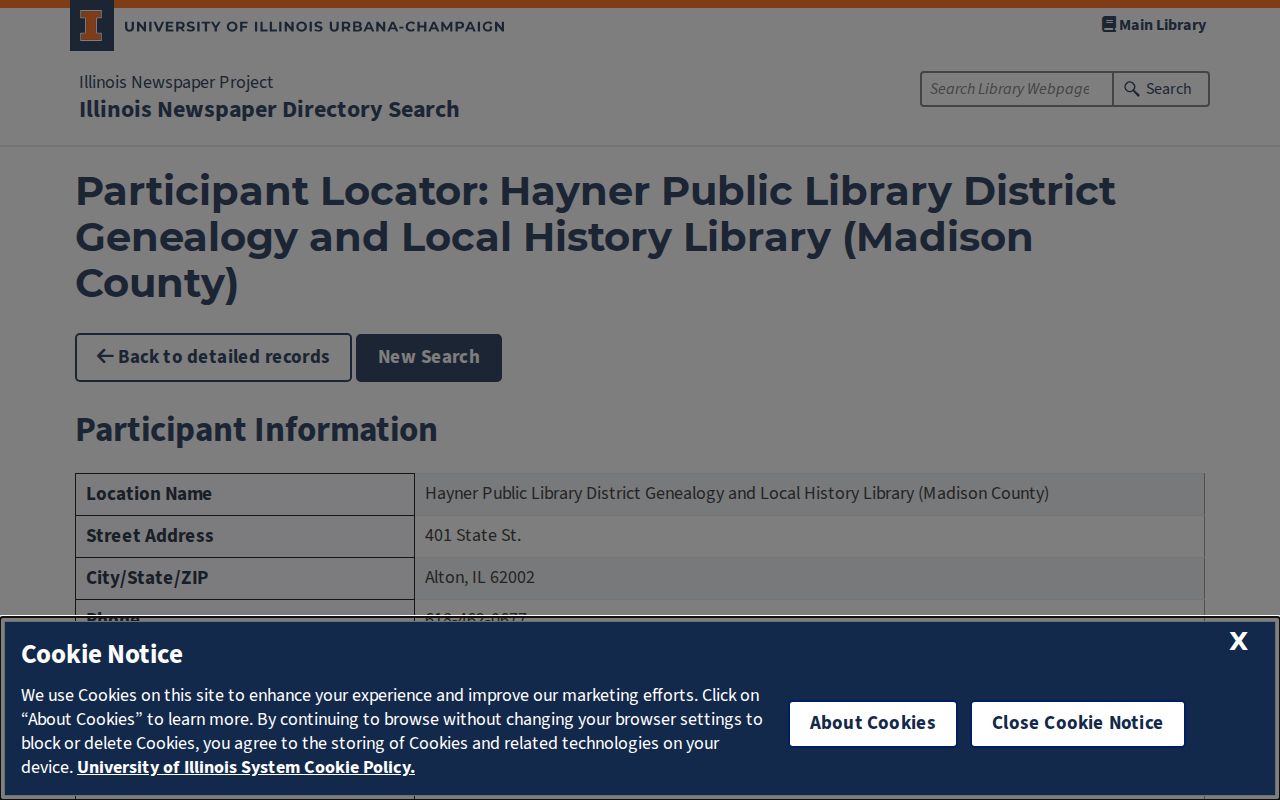
Hayner describes digitized Alton newspapers from 1836 through 2012, plus newer licensed access. The title changed over time. Searches may need Alton Observer, Alton Telegraph, Alton Evening Telegraph, Alton Weekly Courier, Alton Weekly Telegraph, and later Telegraph forms. The Illinois Newspaper Project listing for Hayner helps pick a title and date range.
The title-level holdings screen is valuable when a database search silently overlooks a variant newspaper name.
An obituary or public notice can connect a directory person to relatives, a church, cemetery, business, or former address. Treat it as corroboration. NewsBank coverage is split by period, with full-color access from 2020 forward, text from 2007 forward, and 2012 through 2019 available in the library due to copyright.
Place Alton Entries on Old Maps
A directory supplies a name and address; a fire-insurance map supplies the built setting. The Library of Congress Alton set has 14 sheets dated January 1892. The University of Illinois 1926 map set has 82 leaves plus three unnumbered leaves. It can show lot and block numbers, street layout, building material, industrial or commercial use, and water facilities.
These maps cannot identify every resident. They help test whether the address existed, whether a building footprint changed, or whether an old district label needs to be reconciled with a modern parcel. Hayner's plats, atlases, and Alton Property Research File add another local bridge. The modern address chain belongs in the Alton street directory.
Note: Keep the historical street text beside its modern form, especially for Upper Alton, Lower Alton, riverfront, ward, and postal labels.
Alton Classmates and Family Clues
Yearbooks can extend a name beyond a directory entry. Hayner lists the Alton High Tatler in various years beginning in 1905, Marquette Explorer beginning in 1961, Monticello Seminary Echo beginning in 1838, Shurtleff Retrospect beginning in 1911, and Western Military Academy Recall beginning in 1924. Some are digitized. A yearbook can distinguish a former classmate by school, activity, or class year, but it should not be treated as proof of a later address.
Other companions include Madison County naturalization and intent material from 1816 through 1900, local marriage and vital indexes, Marks Funeral Home Records, cemetery inventories, HeritageHub notices, and church histories. Match dates and family links before combining records. The county Recorder's cemetery table is a local oddity: organizational instruments for Alton cemetery bodies have book-and-page references from 1871 through 1925. Those are institutional land records, not burial entries.
Madison County's Second Research Desk
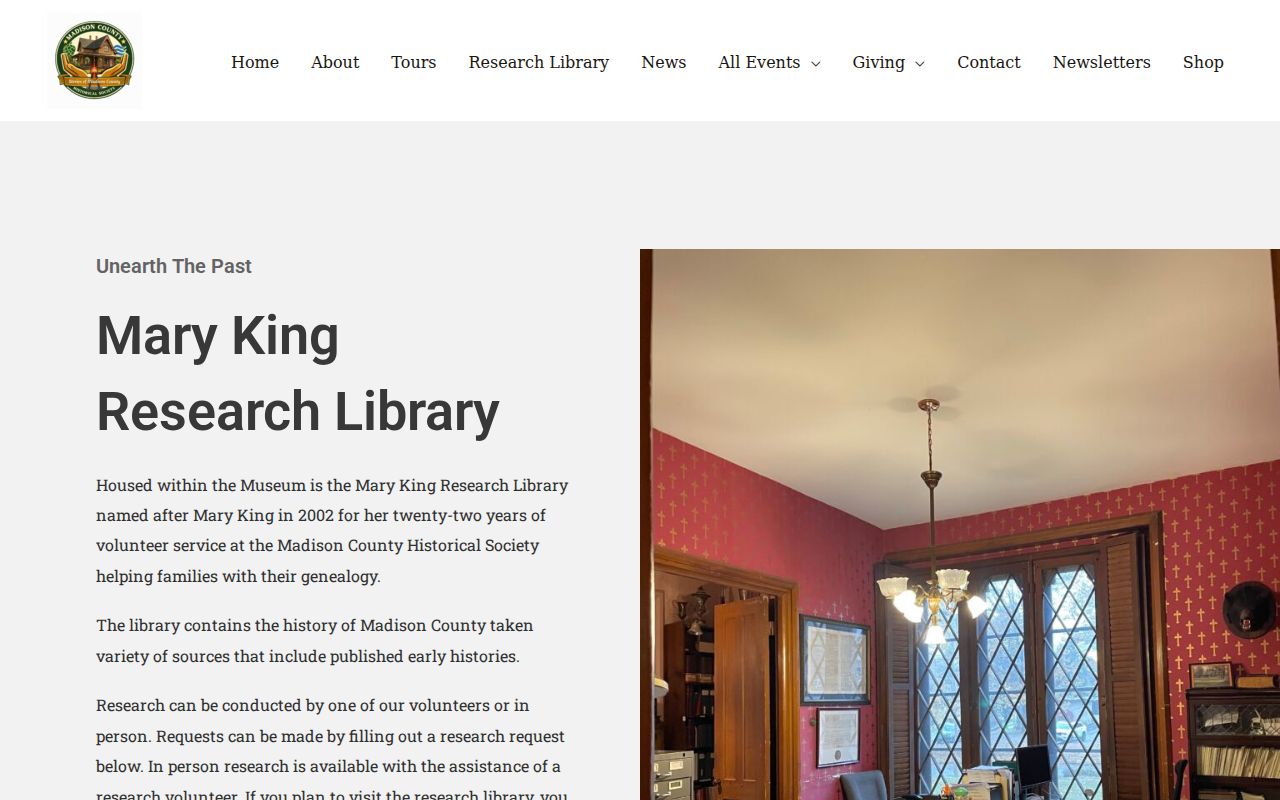
The Mary King Research Library of the Madison County Historical Society holds county statistics, published histories, newspapers and microfilm, photographs, and other local material. Access is appointment-based, and the public page does not publish a complete catalog, every year run, or all reproduction rules. Contact staff with a name, place, date range, and the Alton citation already found.
The library's public page makes the appointment and collection role clear.
This is a handoff, not a duplicate search. Hayner can identify the directory and local index; the historical society may supply county context or a photograph; county and state custodians issue official record copies.
Trace Family Through Alton Directories
Directory years can fill space between census enumerations. Hayner's Madison County federal-census indexes cover 1820 through 1930, while its state material includes early returns and indexes for 1845 and 1855. A directory is commercial, year-specific evidence; a census records a household at an enumeration date. Use the two together, then check newspapers, deeds, probate, vital indexes, or cemetery material.
- Choose Alton and a narrow year range. Check the volume's title page so nearby towns are not merged into the city.
- Find the name alphabetically and save the exact spelling, initials, address, status notation, page, and year.
- Compare adjacent available years. Note a move, changed spouse notation, business change, or missing year without assuming the reason.
- Pair the city directory entry with the closest available census index and schedule. Test age, relatives, birthplace, and location as that census permits.
- Close the trail with a newspaper notice, deed, probate file, yearbook, funeral record, vital index, or cemetery source.
A person can disappear because the volume is missing, the household was omitted, the name changed, the person moved, or the person died. Search surname variants and initials, then use a dated second source. Common names in a long-established river city require care. A spouse, relative, school, cemetery, business, deed, and address can separate two people, but an occupation line alone does not prove identity.